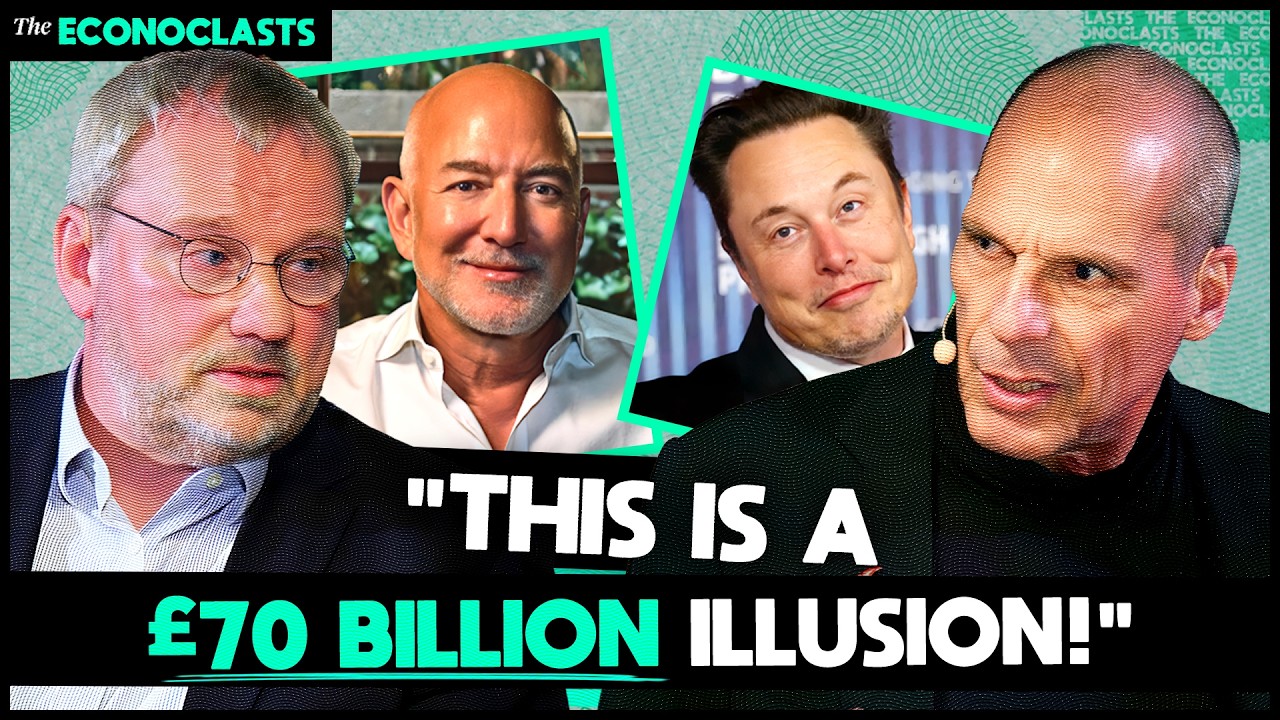
Europe’s Economic Doom Loop: Why Brussels Has Lost the Wheel
Europe’s economic engine is sputtering, and according to two of the continent’s most prominent economic voices, the drivers in Brussels have lost control of the vehicle. In a recent discussion, former Greek Finance Minister Yanis Varoufakis and Financial Times columnist Wolfgang Münchau painted a s
Europe’s economic engine is sputtering, and according to two of the continent’s most prominent economic voices, the drivers in Brussels have lost control of the vehicle. In a recent discussion, former Greek Finance Minister Yanis Varoufakis and Financial Times columnist Wolfgang Münchau painted a stark picture of the European Union’s current predicament: a self-reinforcing cycle of stagnation, political paralysis, and a dangerous reliance on fiscal dogma. Their diagnosis centers on a "doom loop" where sluggish growth, rising debt, and a refusal to embrace structural change are pushing the bloc toward a precipice. While the debate over wealth taxes offers a potential lifeline, the experts argue that Europe’s institutional framework remains fundamentally incapable of implementing the radical solutions required.
The Anatomy of the Doom Loop
The conversation begins with a grim assessment of the European economy. It is not merely a cyclical downturn; it is a structural trap. The "doom loop" describes a situation where low growth leads to high debt-to-GDP ratios, which in turn forces governments to implement austerity measures. These measures suppress demand further, leading to even lower growth and higher debt. This cycle is particularly acute in the Eurozone’s periphery but is now threatening the core.
Varoufakis and Münchau argue that the European Central Bank’s (ECB) primary tool—interest rate policy—is ineffective in this environment. Raising rates to combat inflation does little to cool demand driven by supply-side shocks, but it does increase the cost of servicing sovereign debt, tightening the fiscal screws on already-strained member states. Conversely, lowering rates does not spur investment because the private sector is deleveraging and lacks confidence in the future. The bloc is thus trapped between the Scylla of inflation and the Charybdis of recession, with monetary policy rendered impotent.
The Wealth Tax Mirage
The discussion turns to the proposed solution of wealth taxes, a topic gaining traction in political circles. The idea is to tax accumulated capital to fund social programs and reduce inequality. However, both experts are deeply skeptical of its efficacy as a panacea.
The core problem is not a lack of revenue, but a lack of investment. A wealth tax, they contend, would primarily target real estate and financial assets. In a climate of low growth, taxing capital further disincentivizes the very risk-taking needed to fuel innovation. Furthermore, Europe faces a capital flight problem; high-net-worth individuals and corporations can easily relocate their assets to jurisdictions with more favorable tax regimes, such as the United States or Singapore. Implementing a unilateral wealth tax without global coordination would be economically suicidal, shrinking the tax base and accelerating the exodus of talent.
The German Paradox and the Fiscal Straightjacket
The conversation zeroes in on Germany, the bloc's economic heavyweight, which is facing its own existential crisis. The German economic model, built on cheap Russian energy and exports to China, has been shattered. Yet, Berlin remains ideologically opposed to the fiscal transfers required to stabilize the Eurozone.
Münchau highlights a fundamental paradox: Germany’s constitutional "debt brake" (Schuldenbremse) limits new borrowing, forcing the country to run surpluses. While this is fiscally conservative, it exports deflationary pressure to the rest of the Eurozone. Germany’s refusal to invest domestically and stimulate demand forces the periphery to bear the burden of adjustment, exacerbating the doom loop. The experts argue that without a fundamental overhaul of these fiscal rules—allowing for joint investment and debt mutualization—the Eurozone cannot function effectively.
The Institutional Vacuum
The underlying theme of the discussion is a crisis of governance. The EU’s institutional architecture, designed for a different era, is too fragmented to respond to a polycrisis. The "Brussels bureaucracy" lacks the democratic legitimacy and the executive power to make swift, decisive economic decisions. The requirement for unanimity on major fiscal issues means that a single recalcitrant member state can veto progress, holding the entire bloc hostage to its national interests.
Varoufakis argues that Europe has not lost control because of a lack of intelligence, but because of a lack of sovereignty. The economic policies are dictated by an unelected technocracy that is beholden to a neoliberal consensus, which has demonstrably failed. This has led to a rise in populism and political instability, further undermining the ability of governments to implement long-term structural reforms.
Conclusion: A Call for a New Paradigm
The article concludes that Europe is not facing a simple policy error, but a systemic failure. The "doom loop" is a feature, not a bug, of the current economic governance model. The debate about wealth taxes is a distraction from the more painful truth: Europe needs a new fiscal framework that allows for collective investment, a central bank willing to act as a lender of last resort for governments, and a political structure that can make decisions without being paralyzed by consensus.
Without this fundamental reset, the experts warn, Europe will continue its slow decline into economic irrelevance, losing control not just of its economy, but of its political destiny. The choice is not between austerity and profligacy, but between a bold new federalism and a slow, grinding fragmentation.
Related Coverage
Fossil Fuel Addiction Is Crushing Economies, UN Climate Chief Warns at Bonn Talks
The world’s addiction to fossil fuels is driving economic chaos and making countries more vulnerable to climate disasters, the United Nations’ top climate official warned this week as mid-year talks opened in Bonn. At the same time, disability groups are demanding a seat at the table at the upcoming COP31 summit, and Amnesty International is calling on host nation Turkey to guarantee free speech for all participants.
Global Economy Buckles Under War, Climate Chaos, and Financial Greed
A global economy built on the promise of open trade and cheap energy is buckling under the weight of geopolitical conflict, strategic blockades, and a climate crisis that is no longer a distant warning but a lived reality. From the battlefields of Ukraine and the besieged oil routes of the Middle East to the drought-parched heart of Europe, the pursuit of geopolitical power and corporate profit is increasingly colliding with fundamental human needs, leaving the world’s most vulnerable populations to bear the heaviest burden of inflation, fuel shortages, and a widening gap between the wealthy and the rest [1][2].
Global Economy Buckles as War, Climate Chaos, and Financial Greed Reshape the World Order
A global economy built on the promise of open trade and cheap energy is buckling under the weight of geopolitical conflict, strategic blockades, and a climate crisis that is no longer a distant warning but a lived reality. From the besieged oil routes of the Middle East and the battlefields of Ukraine to the drought-parched heart of Europe, the pursuit of geopolitical power and corporate profit is increasingly colliding with fundamental human needs. This convergence of crises is leaving the world’s most vulnerable populations to bear the heaviest burden of inflation, fuel shortages, and a widening chasm between financial accumulation and human welfare [1][2].
War, Drought, and Debt: How a Strained Global Economy Is Crushing the Vulnerable
A global economy built on the promise of open trade and cheap energy is buckling under the weight of geopolitical conflict, strategic blockades, and a climate crisis that is no longer a distant warning but a lived reality. From the battlefields of Ukraine and the besieged oil routes of the Middle East to the drought-parched heart of Europe, the pursuit of geopolitical power and corporate profit is increasingly colliding with fundamental human needs, leaving ordinary citizens to bear the brunt of inflation, fuel shortages, and a widening gap between the wealthy and the rest.
Russia Fires Top Economist Who Warned War Effort Is Unsustainable — Kremlin Cracks Show as Election Nears
A senior Russian economist has been fired after warning the Kremlin that the country cannot sustain a prolonged war with Ukraine, while a Swedish TV host’s on-air slip has become a national story about political masks falling on election night.
Related Editorials
Europe’s Decline is Now Official: The Continent Has Lost Its Economic Soul
In a rare moment of bipartisan agreement, two of Europe’s most astute economic minds—Yanis Varoufakis, the former Greek Finance Minister, and Wolfgang Münchau, a veteran financial journalist and co-founder of *The Econoclasts*—have declared the end of an era. The evidence, they argue, is no longer
Germany’s Economic Model Is Broken—and There’s No Going Back
Germany, long celebrated as Europe’s economic engine, is now facing a crisis that its political and financial leaders appear unwilling—or unable—to confront. In a candid discussion, economists Yanis Varoufakis and Wolfgang Münchau dissect the structural failures behind Germany’s stagnation, the Eur
Germany’s Economic Engine Sputters: Why the World’s Former Export Champion Is Running Out of Steam
For decades, Germany was the gold standard of European economic might—a manufacturing powerhouse whose efficiency, discipline, and engineering prowess powered the continent. Today, that engine is sputtering.
Germany Just Broke the EU’s Firewall
A conversation between Yanis Varoufakis and Wolfgang Münchau reveals how Berlin’s fiscal about-face is rewriting the rules of Europe—and why the bond markets may be the only referee left. For years, the European Union’s fiscal architecture rested on a simple promise: no member state would be allowe
Germany Has Just Hit the Point of No Return
In a stark and urgent analysis, economist Yanis Varoufakis and journalist Wolfgang Münchau argue that Germany’s economic model has reached a critical juncture—a “point of no return. ” The conversation, hosted on *The Econoclasts*, dissects the structural collapse of the German economy, moving beyond
Keir Starmer’s Resignation: The Vacuum, the Right, and the Road to Realignment
In a political landscape already fracturing under the weight of austerity and stagnation, the resignation of UK Labour leader Keir Starmer marks a pivotal moment. But as economists Yanis Varoufakis and Wolfgang Münchau argue in a recent episode of *The Econoclasts*, the departure is less a solution