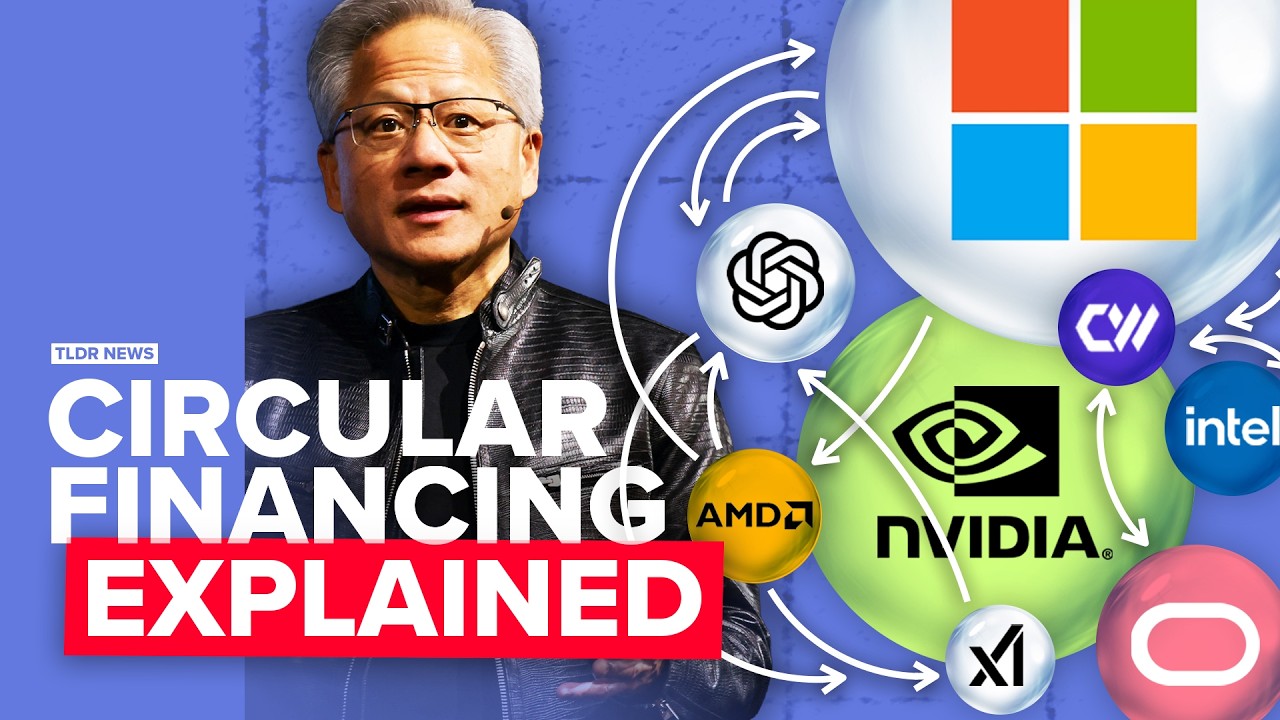
The Hidden Cost of Circular AI Financing: A Convenient Myth or a Looming Debt Trap?
In the rush to fund the artificial intelligence boom, a new buzzword has entered the boardroom lexicon: "circular AI financing. " On its surface, the term suggests a sustainable, self-feeding economic loop—where profits from AI fund more AI, creating a virtuous cycle of innovation.
In the rush to fund the artificial intelligence boom, a new buzzword has entered the boardroom lexicon: "circular AI financing." On its surface, the term suggests a sustainable, self-feeding economic loop—where profits from AI fund more AI, creating a virtuous cycle of innovation. But beneath this clean veneer lies a more complex and troubling reality. As investors and tech giants tout the benefits, a growing chorus of analysts warns that this model may be less about sustainability and more about a precarious house of cards. This article dissects the mechanics of this financing trend, separating the genuine opportunities from the significant risks.
What Is Circular AI Financing?
At its core, circular AI financing describes a scenario where the primary customers of an AI company are other AI companies. This can manifest in two distinct ways. First, it occurs through direct infrastructure spending, where a firm like a cloud provider uses its own AI services to improve its data centers, which are then sold to other AI startups. Second, and more dangerously, it involves a financial loop: Company A invests in Company B, which uses that capital to purchase AI services from Company A. The revenue appears on Company A's books as growth, but the cash flow is entirely dependent on the continued availability of external capital to keep the loop spinning.
The Allure of the Loop
Proponents argue that this model accelerates the development of critical infrastructure. By using AI to optimize chip design or data center cooling, companies can achieve breakthroughs faster than traditional linear R&D. Furthermore, in a high-interest-rate environment, this model allows for rapid scaling without the need for immediate end-user revenue. It creates an ecosystem where the "plumbing" of AI gets built at an unprecedented pace, theoretically benefiting everyone downstream.
The Cracks in the Foundation
However, the risks are substantial. The primary concern is the lack of "real" external demand. If the end-user market for AI applications (e.g., enterprise software, consumer apps) fails to generate sufficient revenue to justify the infrastructure costs, the entire loop collapses. This is not merely a theoretical risk.
The model relies on a continuous influx of new capital. When the Federal Reserve tightens monetary policy or venture capital dries up, the loop breaks. The "revenue" generated by Company A is not from a profitable, external sale; it is a loan from Company B’s investors. This is functionally equivalent to a company lending money to its customers to buy its products—a practice that inflates sales figures but does not improve underlying profitability.
Distinguishing Signal from Noise
It is crucial to distinguish between healthy internal efficiency and problematic financial engineering. When a company uses its own AI to reduce operational costs—such as automating customer support—that is a genuine efficiency gain. It reduces expenses and improves margins. Conversely, when a company books revenue from a counterparty whose only source of funds is a venture capital round that is contingent on that same revenue, the transaction is circular in the most literal sense.
The key metric for investors to watch is not gross revenue growth, but "net external revenue"—the amount of money coming from customers who are solving a real problem for a real end-user. If that number stagnates while total revenue soars, it is a red flag.
The Verdict
Is circular AI financing "as bad as it sounds"? The answer is nuanced. As a tool for internal optimization and infrastructure acceleration, it is a powerful and legitimate strategy. As a substitute for genuine market validation, it is a dangerous illusion.
The current market is rife with examples of companies that have used this model to achieve astronomical valuations. The danger is that when the music stops, the "circular" nature of the cash flow becomes painfully apparent. For the industry to mature, it must transition from a cycle of funding-driven growth to a cycle of product-driven demand. Until then, the loop remains a beautiful, but fragile, financial construction.
Related Coverage
The AI Boom Is a Power Grab: How Compute, Debt, and Geopolitics Are Redrawing the Global Order
The artificial intelligence boom is not a neutral technological revolution. It is a geopolitical and economic battleground where control over chips, data, and capital is reshaping the balance of power between states and corporations, while workers and global financial markets absorb the shockwaves. The most immediate threat to the global economy is not AI itself, but the debt being piled up to build it, as massive borrowing by tech giants to construct data centers creates a bubble that central banks and Norway's $1.8 trillion sovereign wealth fund warn is overheating [1][2].
The AI Boom Is a Power Play: How Compute, Debt, and Geopolitical Rivalry Are Reshaping Global Control
The artificial intelligence boom is not a neutral technological revolution; it is a geopolitical and economic battleground where control over chips, data, and capital is redrawing the balance of power between states and corporations, while workers and global financial markets absorb the shockwaves. The most immediate threat to the global economy is not AI itself, but the debt being piled up to build it, as massive borrowing by tech giants to construct data centers creates a bubble that central banks and sovereign wealth funds warn is overheating [1][2]. Meanwhile, China is executing a carefully calibrated strategy to build its own AI ecosystem independent of American technology, positioning itself as a global rule-maker and forcing smaller nations to choose sides in a contest that will shape the world's technological future [3][4].
# The AI Power Grab: Debt, Data Centers, and the New Geopolitics of Control
The artificial intelligence boom is not a neutral technological revolution—it is a geopolitical and economic battleground where control over chips, data, and capital is reshaping the balance of power between states and corporations, while workers and global financial markets absorb the shockwaves [1][2].
# The AI Power Grab: How Compute, Debt, and Geopolitics Are Redrawing the Global Order
The artificial intelligence boom is not a neutral technological revolution—it is a geopolitical and economic battleground where control over chips, data, and capital is reshaping the balance of power between states and corporations, while workers and global financial markets absorb the shockwaves.
# The AI Power Grab: How Compute, Debt, and Geopolitics Are Reshaping Global Control
The artificial intelligence boom is not a neutral technological revolution—it is a geopolitical and economic battleground where control over chips, data, and capital is reshaping the balance of power between states and corporations, while workers and global financial markets absorb the shockwaves.
# The AI Boom Is a Power Play: How Compute, Debt, and Labor Are Reshaping the Global Order
The artificial intelligence boom is not a neutral technological revolution—it is a geopolitical and economic battleground where control over chips, data, and capital is redrawing the balance of power between states and corporations, while workers and global financial markets absorb the shockwaves.
Related Editorials
The AI Bubble Is Inflating Faster Than You Think
The artificial intelligence industry is experiencing a surge of exuberance that bears striking resemblance to the dot-com era. Recent market movements, product launches, and investor behavior suggest that the AI sector has entered what many analysts describe as a "bubbly" phase—a period of rapid va
The Hidden Debt Crisis Threatening the Future of Artificial Intelligence
Article: The artificial intelligence industry is facing a financial reckoning that most investors and policymakers have yet to fully grasp. While the public conversation focuses on breakthrough capabilities and existential risks, a quieter but equally dangerous problem is building beneath the surfa
The Invisible Fault Line: How an AI Crash Could Unravel the Global Economy
Artificial intelligence is no longer a futuristic concept confined to research labs. It is the silent engine powering modern finance, logistics, and communication.
The Real AI Threat Isn’t What You Think
Yanis Varoufakis and Wolfgang Münchau argue the danger isn’t robots taking over—it’s the private seizure of the digital commons. Politicians and pundits warn endlessly about artificial intelligence turning on humanity.
The Specialist Paradox: Why AI Isn’t Making Experts Obsolete—It’s Redefining Them
A provocative question is circulating in boardrooms and research labs alike: Has artificial intelligence rendered human specialists obsolete? The short answer, according to emerging evidence, is no.