Gaza's fishermen: "I don't know if I will return"
Before October 2023, small fishing boats dotted the Mediterranean coast of Gaza at dawn. Fishermen repaired nets on the sand while gulls cried overhead. The sea was their livelihood, passed from father to son for generations.
Saeed Al-Shantaf, 35, started fishing at age 11. His father and grandfather did the same. "We go from the sea to our homes, and from our homes to the sea," he says.
Today, that simple journey has become life-threatening. Each morning before leaving, Saeed tells his wife: "Take care of the children. I don't know if I will return."
The fishing industry in Gaza has been nearly destroyed. According to Zakaria Bakr of the General Union of Fishermen and Marine Production Workers, more than 95% of the sector has been wiped out since October 2023. Boats, engines, storage facilities, workshops, and shipbuilding sites are gone. Four ice factories that served the industry were also destroyed.
Before the war, Gaza's fishermen produced 15 to 20 tons of fish per day. Now they produce barely 10 to 15 tons in an entire month. Over 4,500 fishermen are unemployed. Only about 600 or 700 of the roughly 5,000 fishermen still work at sea.
The waters were already restricted before the war. Fishermen could only access zones extending six to twelve nautical miles from shore. Now, even that limited access is gone.
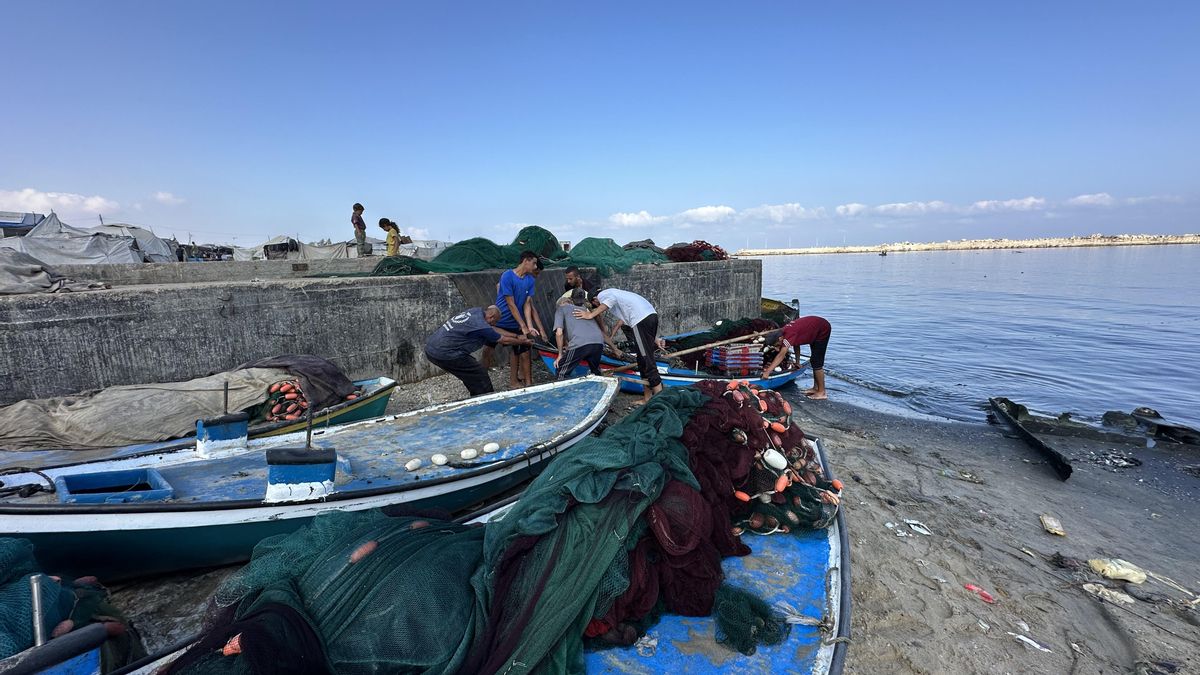
At the damaged port, fishermen try to rebuild with whatever they find. They recover nets from rubble. They patch together old equipment. Motorized boats have been largely replaced by simple rowboats.
"We have returned to the sixties and seventies," says Nidal Al-Daour, 40, a refugee from the occupied village of Hiribya. Before October 7, he worked on a trawler about 25 meters long. Now he stays mostly on land.
According to Bakr, Gaza had approximately 96 large fishing boats before the war. Almost none have survived. Around 800 boats now sit submerged in the port basin.
The destruction affects more than work—it affects survival. "You go to a fisherman's house and find he has no food," says Nidal. "He has to borrow money just to eat."
Even if fishermen could suddenly return to the sea freely, most lack the boats, engines, and equipment needed to work.
Saeed continues to go to the coast every morning. He knows the danger. He has lost colleagues. He recalls being shot at while leaving the port and jumping into the water after his small boat was damaged.
But fishing is the only profession he knows. "If I tried to work somewhere else, I wouldn't know how to do anything," he says.
His request is simple: boats in good condition, nets, engines, safe access to fishing zones, and the ability to leave home without wondering if he will come back.
"Give us space to live and security so we can go out and return."
For now, he keeps visiting the shore each morning. The boats may be gone, the nets torn, and the sea dangerous—but he still goes to greet it.