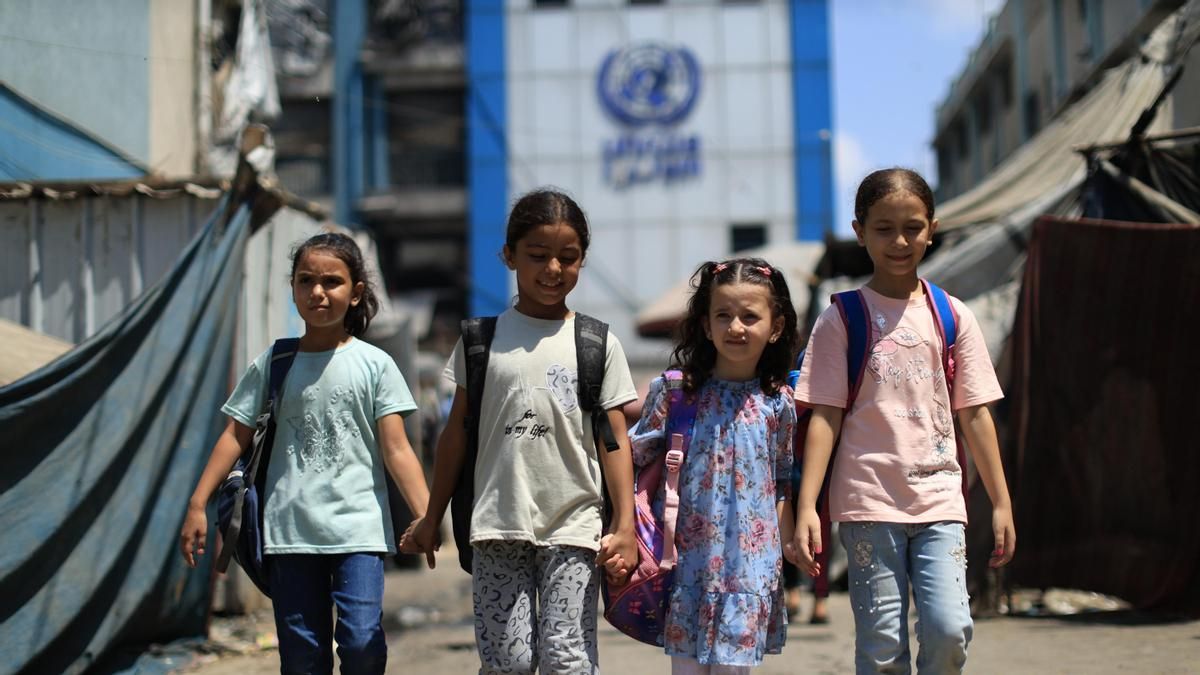
Gaza’s Children Return to Class in Rubble, Not Classrooms
Mona walks through Gaza with her backpack, excited for the first day of school. In Spain, this scene is normal. Children return to class after summer, see their friends, and slowly get back into a routine. In Gaza, going back to school is nothing like this.
For children there, returning to school has become an obstacle course. It offers a ray of hope, but the conditions are far from guaranteeing the right to learn.
Trauma, pain, and loss fill the daily lives of these children. Between October 2023 and September 2025, the Israeli offensive killed more than 17,200 students and 600 teachers. It also injured over 25,000 students and 3,000 teachers.
Mona is six years old. She lost her parents during the Israeli offensive and now lives with her aunt. Like her, hundreds of thousands of children in Gaza have lived through nearly three years of violence, loss, and displacement. For them, learning again is not just about going back to class. It means having a comforting space, being with their teachers, having a routine, and finding relief from anxiety and fear. After so much suffering, learning again is also the simple and valuable chance to be children again.
The destruction across Gaza is total. The education sector has been reduced to rubble. Between October 2023 and November 2025, 97.5% of schools suffered some damage. One third of these were UNRWA schools. More than 93.3% were severely damaged. Since then, more than 450 school buildings — over 80% of all education buildings in Gaza — have been directly hit. Most schools have also become emergency shelters for thousands of displaced families. Today, UNRWA has 114 shelter schools, where 65,000 people are surviving. This only allows the agency to open small learning spaces in some shelters.
Israel’s siege of Gaza makes everything worse. The shortage of supplies has serious consequences for education. Materials to rebuild schools and classrooms are hard to find. There are no desks. Students must sit on the floor during learning activities. They barely have school supplies like backpacks, books, or notebooks. No child deserves to return to class under these conditions.
After so much suffering, children in Gaza need learning to move forward. Not having access to education has negative effects in the short and long term. Immediately, this lack causes delays in learning development and normal school progress. The consequences will last for years. Despite the terrible context, temporary classrooms in Gaza are a source of hope and a lifeline for students.
**A Challenge for UNRWA: Starting the School Year Mid-Crisis**
UNRWA has worked to start the 2026-2027 school year on September 19 with the best possible conditions for students. After the 2025-2026 academic year ended, agency professionals organized summer activities for more than 47,000 children. They also began planning for the next year.
In total, UNRWA has 686 temporary learning classrooms across 83 shelters it keeps operating. Since the ceasefire in October 2025, agency teams have focused on returning to learning and rehabilitating safe spaces for students. With few resources and materials, they also had to find simple solutions to prepare these spaces, such as building desks from pallets. Bringing childhood back and giving thousands of children a reason to smile was their motivation and goal.
In these temporary learning spaces, more than 3,000 UNRWA education staff work so students can learn to read, write, and do math again. These professionals are also essential for giving students support that eases their emotional burdens. Thousands of children like Mona see these places as somewhere to feel accompanied. But these spaces are not only hope for students. Their parents, mothers, or caregivers find relief from the burden of care and a reason to believe in a hopeful future. “Today I see Mona smiling and progressing at school again. It gives me hope to think that together we can continue this path toward a safer and brighter future,” her aunt says emotionally.
While we continue to demand the conditions that guarantee their right to a dignified, safe, and quality education, keeping these learning spaces open is a way to stand with them and help them recover part of the childhood that violence has taken from them.