Gaza Mothers Battle Winter: "I Wake to Check If My Children Are Still Breathing"
Standing in the hallway of a UNRWA school-turned-shelter in western Gaza City, Rajaa Jindiya watched rainwater flood the tent where her children sleep. The 30-year-old Palestinian widow has lived in an improvised tent for over two years, since Israeli bombardment destroyed her home.
Each winter, she tries to prepare. Each rainstorm, the tent floods anyway—soaking mattresses, blankets, her children's clothes, and the little food she has gathered. "Every rain destroys another part of the tent, which barely stands after two years and multiple displacements," Jindiya said.
"When it rains at night, we stay awake all night, trying to take shelter from the rain in the school buildings and hallways and dry ourselves. My children shiver from the cold, but I can do nothing, as all the blankets and their clothes end up soaked."
Some nights, Jindiya and her children find space in classrooms converted into shelters. Other nights, the rooms are overcrowded, and she sits on the stairs until morning. At dawn, she returns to her tent and lays the mattresses and blankets in the sun to dry.
Some of her blankets came from UNRWA as emergency winter aid. She has carried them through every displacement. "I cannot afford to lose any blanket. Even when a blanket wears out, I try to sew it and patch it so it lasts longer," she said.
"It is freezing cold here all night. I wake up again and again to check if my children are still breathing and to make sure they have at least some warmth. It torments me to think they could die of cold."
Winter has become a deadly threat for displaced children in Gaza, especially newborns and infants, whose families lack adequate shelter, heating, and warm clothing.
According to OCHA, recent rains in Gaza have affected more than 220,000 people and damaged over 40,000 family shelters. After these first floods, an estimated 5,000 people are forced to sleep in the open.
**No Escape from the Floods**
In the classroom next to Jindiya's tent, two families—nine people in total—have taken refuge. An elderly woman, Um Kamal Ubeid, says she is lucky to have a roof over her head. "I am an old woman. I cannot bear living in a tent. During the first weeks of the offensive, I moved from place to place and spent months living in tents. This has deeply affected my health," said Ubeid, 71.
"At my age, I feel the cold much more than young people, and at night, I keep asking my grandchildren to put another blanket over me. I feel like I am freezing."
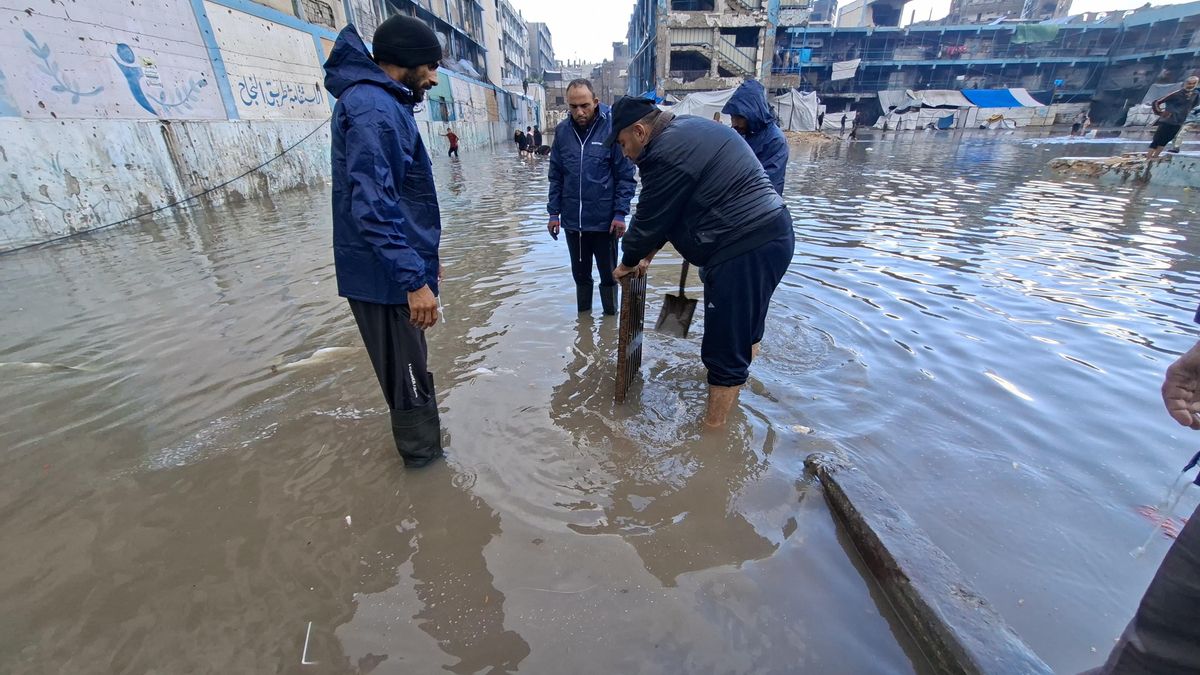
But Ubeid says the winter problem is not only finding a place with a roof—it is also moving from one place to another without crossing floodwaters contaminated with sewage that fill the streets.
The Israeli military has destroyed or severely damaged much of Gaza's water and sanitation infrastructure, including sewage networks, pumping stations, and drainage systems. This has left many areas unable to cope with heavy rain. As a result, rainwater accumulates in streets and displacement camps, where it often mixes with sewage and overflows into tents, shelters, and damaged homes.
UNRWA is working to reduce flood risk in its shelters and surrounding areas by clearing blocked drainage networks, removing sewage and solid waste, and preparing flood-prone sites before winter. However, the agency's efforts remain severely limited by supply shortages. Many water pumps have stopped working due to a lack of engine oil and spare parts, while Israeli restrictions on heavy machinery have made winter preparations even harder.
"During the hardest winter moments, I do not leave the classroom for days, sometimes even weeks. I cannot walk the streets. They are usually flooded, making movement difficult even for young people, and much more so for elderly and sick people like me," Jindiya added.
"Before October 2023, we loved winter. We prepared soup and hot drinks while enjoying the sound of raindrops on our windows. Today, winter is a nightmare in every way."