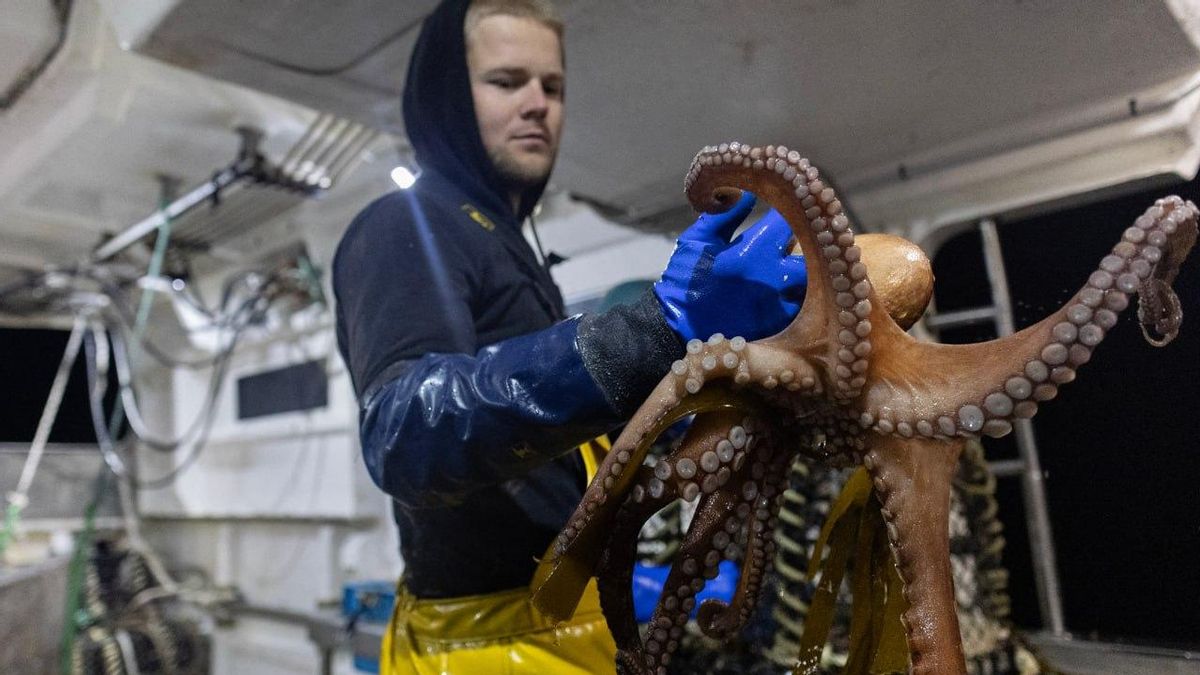
Octopus 'Invasion' Hits UK Coasts While Galicia's Catch Collapses
The common octopus (*Octopus vulgaris*) is experiencing a population explosion off the southwestern UK and Brittany's coasts, a boom that contrasts sharply with decades of decline in Galicia, Spain. Experts report that octopus catches in British waters in 2025 were 65 times higher than average, with northern France seeing a similar surge. This shift has led Galicia to import octopus from these northern latitudes for the first time, as local fishermen transform their view of the creature from pest to resource.
The phenomenon began intensifying in 2021, according to Ángel Guerra, a CSIC researcher and leading authority on cephalopods. "There were octopus in both places, but the local population wasn't enough to cause a plague. The main reason is that the entire English Channel has warmed," he says. This heat has created ideal conditions for the species, which thrives in temperate and warm waters.
Experts clarify that Galician octopuses have not migrated north in a mass exodus. Instead, local populations in the UK and France have found conditions perfect for proliferation. "They've always been there. It's not that the octopus suddenly arrived, but that it was in low abundance and now the temperature has favored a population boom," explains Alejandro Escánez, a cephalopod expert at the University of La Laguna.
Recent research identifies the cause as the migration of octopus larvae to English shores, carried by currents and winds from the Channel toward the rocky seabeds of Brittany, Devon, and Cornwall—ideal habitats for them. The study, led by Bryce Stewart, shows octopuses have spread as far as Scotland's northern coast, with one Devon market selling 100 tons in a single day.
The warmer water has triggered what scientists call the "Forsythe effect." Baptiste Le Bourg, a marine biologist at the Concarneau Marine Station, notes that octopuses in the north are larger than their Galician counterparts. "A higher temperature at certain stages means that, if the animal gets enough energy, it grows faster," he explains. This rapid growth is supported by abundant plankton and a lack of natural predators due to overfishing in the area.
This is not the first time the region has seen such an explosion. Two similar events occurred between 1889 and 1900, and again between 1950 and 1951. However, those populations collapsed after extremely cold winters in 1962 and 1963. Historically, the British have not valued the creature. "The English don't consume cephalopods; they find the suckers repugnant. For them, the octopus is at the same level of plague as jellyfish in the Mediterranean, which is why they export it to us," says Antonio Figueras, a CSIC researcher specializing in marine organisms.
Local fishermen have shifted from concern to opportunism. In Brittany, they now view the octopus as a resource and are working toward sustainable long-term fisheries. This has led to a surge of northern octopus in Spanish markets, where it is larger and cheaper. English fishermen are even adopting Galician fishing methods and commercial classification systems.
Meanwhile, Galicia's octopus landings have seen structural decline since 2000. The 2024-2025 season hit a historic low of just 1,116 tons landed, recovering only slightly to nearly 1,327 tons in 2025-2026 thanks to new management plans and biological closures. Fishermen attribute this to overexploitation and too many boats. "It's not just that there's less resource, but that there are many more people," says Ramón, a fisherman from the Arousa estuary for 40 years.
Scientists point to a combination of factors: overfishing, a drastic drop in plankton due to pollution, and excessive freshwater runoff in rainy years. Guerra notes that the shortage in Galicia will be supplemented by octopus from Brittany and Devon, which he says is nearly identical in flavor and quality to Galician octopus. Local fishermen disagree. "The octopus from outside is much bigger, but they don't fool me. If you try the octopus from there, you'll notice the difference: it's a bit tougher than ours," says Ramón.
The deeper context, experts warn, is climate change. "This isn't just happening with octopus, but with many species, both fish and other invertebrates. Species from southern waters are starting to colonize more northern waters, a phenomenon known as 'tropicalization,'" says Escánez. Figueras emphasizes that the entire ecosystem is out of balance. Galicia's waters experienced extreme thermal anomalies this summer, reaching 24 degrees Celsius—4 to 6 degrees above normal—which is lethal for octopus. "We have to warn people that something very serious is happening, that we are facing the tip of the iceberg," he concludes.