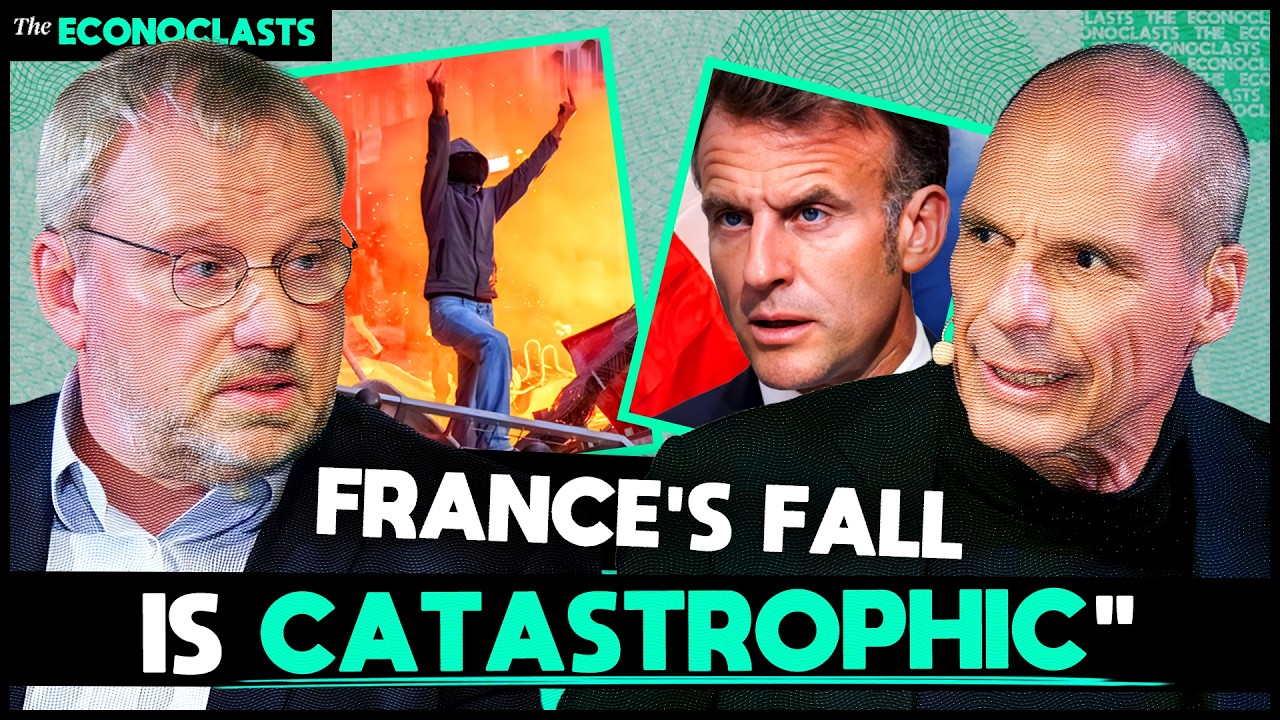
# Has Macron Broken France? A Debate on Debt, Democracy, and the Future of Europe
Two leading economic thinkers argue that France's crisis is deeper than a budget deficit—and that the eurozone's rules may be making it worse. When French President Emmanuel Macron called snap parliamentary elections in the summer of 2024, he framed the vote as a moment of clarification for the
Two leading economic thinkers argue that France's crisis is deeper than a budget deficit—and that the eurozone's rules may be making it worse.
When French President Emmanuel Macron called snap parliamentary elections in the summer of 2024, he framed the vote as a moment of clarification for the nation. Instead, it produced a hung parliament, a weakened president, and a crisis of legitimacy that has since paralyzed French policymaking. In a wide-ranging conversation, economist Yanis Varoufakis and commentator Wolfgang Münchau—co-hosts of The Econoclasts—debate whether Macron has broken France, and whether the damage extends to the European project itself.
A Crisis of Legitimacy, Not Just Budgets
The conversation begins with a fundamental question: what does it mean to say a country is "broken"? For Münchau, the answer lies less in France's deficit figures than in the functioning of its democracy. The French electorate, he argues, has been asked to vote repeatedly—in presidential, legislative, and European elections—without any of those votes producing a government capable of acting. The result is a political system that no longer responds to the people it claims to represent.
Varoufakis goes further. He contends that the problem is structural rather than personal: the eurozone's architecture constrains what any French government can do, regardless of who holds office. A president elected on a mandate for change confronts fiscal rules, treaty obligations, and bond markets that limit the room for maneuver. In this reading, Macron is less the author of France's predicament than its most visible symptom.
The Deficit Debate
Central to the discussion is France's fiscal position. The country's budget deficit has exceeded European Union limits, and its debt burden has drawn scrutiny from Brussels and the bond markets. Münchau notes that France has historically enjoyed favorable borrowing costs, but that this advantage is eroding. Rising interest rates mean the cost of servicing existing debt now consumes a growing share of public spending—crowding out the very investments Macron once promised.
Varoufakis challenges the framing of deficit reduction as a virtue in itself. He argues that austerity, imposed during a period of weak growth, risks deepening the very fiscal problem it aims to solve. Cutting spending reduces demand, slows the economy, and shrinks the tax base—a cycle he says has played out across Europe since the 2010 debt crisis.
Münchau is more cautious. He agrees that indiscriminate austerity is counterproductive, but warns that ignoring debt sustainability carries its own risks. The two converge on a narrower point: the debate over deficits cannot be separated from the debate over democratic accountability. Decisions about spending and taxation, they suggest, should be made by elected governments answerable to voters—not dictated by technocratic rules or market pressure.
Europe's Broader Predicament
The conversation widens to the European Union as a whole. Both participants express concern that the bloc's economic governance has become detached from democratic politics. When fiscal rules bind governments but voters cannot change those rules through the ballot box, the result is what Varoufakis calls a "democratic deficit"—a gap between the locus of decision-making and the locus of accountability.
Münchau points to Germany's own economic difficulties as evidence that the problem is not uniquely French. Europe's largest economy has struggled with stagnant growth, energy costs, and structural weakness in its industrial base. If even Germany is faltering, he argues, the notion that France simply needs to imitate German fiscal discipline becomes harder to sustain.
What Comes Next?
Neither participant offers a simple prescription. Varoufakis calls for a renegotiation of Europe's fiscal framework, arguing that without democratic control over economic policy, political instability will continue to spread. Münchau is skeptical that such a renegotiation is politically feasible, but agrees that the status quo is unsustainable.
What emerges from the discussion is a shared diagnosis: France's crisis is not merely a story about one president or one budget. It is a test case for whether European democracies can reconcile the constraints of monetary union with the demands of democratic legitimacy. On that question, both men suggest, the answer remains dangerously open.
Related Coverage
Turkey's Opposition Leader Challenges Erdoğan to Ballot Box Showdown as Court Weighs Mayor's Detention
Özel dares Erdoğan to face voters directly while European rights court examines whether Istanbul mayor's jailing is part of a broader crackdown on opposition.
Europe’s Ukraine Funding Runs Dry as Leaders Clash Over Money
European Union leaders face a growing dispute over how to fund Ukraine after money ran out sooner than expected.
Europe’s Role in Ukraine Peace Talks: Ceasefire or a New Security Order?
Europe insists on a seat at the table for any peace talks on Russia’s war in Ukraine, but the key question is whether negotiations should focus on a ceasefire or on Moscow’s demand to redraw Europe’s security map.
Le Pen’s Rise in France Puts Ukraine’s Financial Lifeline at Risk
Marine Le Pen’s far-right party could cut off crucial financial support for Ukraine if it wins power in France, a scenario European leaders are not preparing for. The warning comes as Europe focuses on less important debates about who should represent the European Union (EU) in talks with Russia and how United States (US) President Donald Trump is handling Ukraine.
EU Faces Election ‘Supercycle’ as Nationalist Parties Gain Ground
Four of the European Union’s largest member states will hold crucial elections in the coming year, with nationalist and Eurosceptic parties rising in the polls. The results could test the bloc’s unity and resilience.
EU Budget Fight Erupts as Elections Threaten to Blow Up Talks
European Union lawmakers have kicked off negotiations on the bloc's seven-year budget, and it's already shaping up to be a brutal fight. Elections in France, Italy, and elsewhere are making everything harder.
Related Editorials
Germany’s Economic Model Is Broken—and There’s No Going Back
Germany, long celebrated as Europe’s economic engine, is now facing a crisis that its political and financial leaders appear unwilling—or unable—to confront. In a candid discussion, economists Yanis Varoufakis and Wolfgang Münchau dissect the structural failures behind Germany’s stagnation, the Eur
Iceland’s Quiet Revolt: The End of Europe’s Political Illusion?
For decades, the European Union has sold itself as a project of perpetual integration—a political and economic engine designed to smooth over national differences and deliver shared prosperity. Yet, according to two of Europe’s most prominent economic thinkers, the recent actions of a small Nordic
Germany Just Broke the EU’s Firewall
A conversation between Yanis Varoufakis and Wolfgang Münchau reveals how Berlin’s fiscal about-face is rewriting the rules of Europe—and why the bond markets may be the only referee left. For years, the European Union’s fiscal architecture rested on a simple promise: no member state would be allowe
Europe’s Economic Doom Loop: Why Brussels Has Lost the Wheel
Europe’s economic engine is sputtering, and according to two of the continent’s most prominent economic voices, the drivers in Brussels have lost control of the vehicle. In a recent discussion, former Greek Finance Minister Yanis Varoufakis and Financial Times columnist Wolfgang Münchau painted a s
The AI Boom Will Not Crash Europe. Europe Is Already Crashing Itself.
By Yanis Varoufakis and Wolfgang Munchau Two unconventional thinkers on the future of capitalism, the AI race and why Britain's economic model is running on empty. The global economy is being reshaped by two forces that dominate every conference, every boardroom and every finance ministry: the arti
# Is France Abandoning Neoliberalism? A New Economic Era Takes Shape
For decades, France has been a loyal practitioner of neoliberal economics—a model built on free markets, deregulation, privatization, and fiscal austerity. But recent political and economic shifts suggest the country may be charting a different course.